

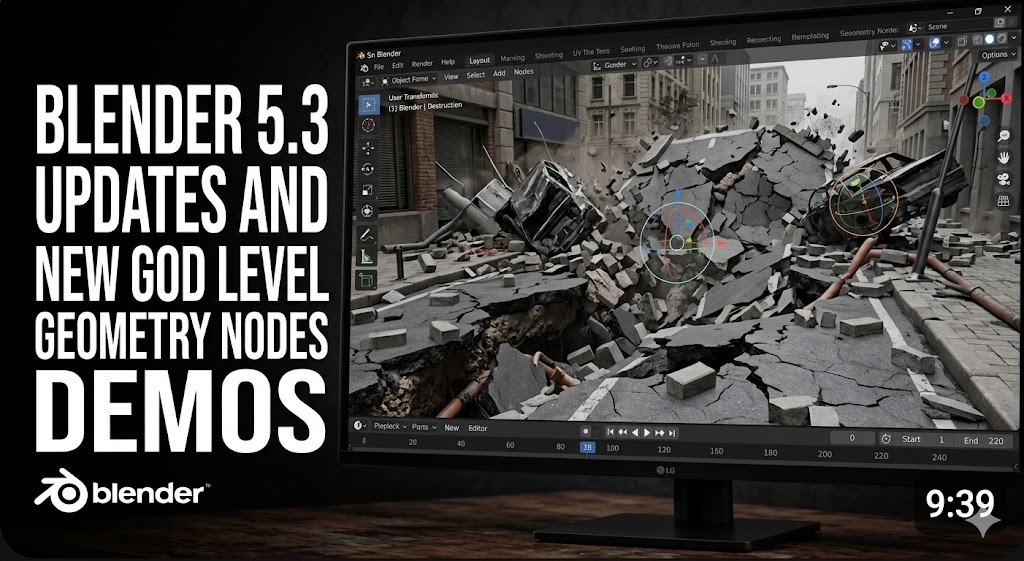
its geometry nodes time, that time where we look at outstanding use of geometry nodes, with mind blowing projects and demonstrations of what can be done using these noodles.
panggolin scales test
starting with this pangolin scales test by cartesian caramel, don’t let the cuteness deceive you. making scales like this that follow the animal’s form and figure and are not just random is no easy task. you could try the hair system but its distribution is random and you don’t get control over the orientation of the scales. if you are thinking of the instance on points nodes, well it’s not that simple either. to instance you first need to distribute points on the mesh, and even then you don’t really have full control over how those points are distributed across the surface. that’s why this demo is deceiving in nature, it looks simple but you will realize the complexity of what is being done here the moment you try to recreate it yourself.
mesh weaver
https://superhivemarket.com/products/mesh-weaver/?ref=311
similarly we have another demo by alex happy, showing how you can turn any mesh into a weaved object. this is a step up from the pangolin scales demo because now you are not just instancing points that follow a pattern, you are creating interlocking splines that follow different designs across the mesh surface. by the way this is a product alex is selling on superhive if you want to check it out and dissect the noodles this is your chance. the generator also creates uvs on the fly, making it easy to export the result to other programs without having to redo the mapping.
tree physics
you probably have never seen trees move like this and it’s all happening in realtime, done entirely in geometry nodes with believable bending and physics. this is jesse miettinen at it again. whenever i think of jiggle physics like this i usually run straight to rigging which can get complicated fast. not saying this setup is simple, it’s probably more complicated than a normal rig, but if we are going to do something complicated anyway it might as well be done with a flexible system like geometry nodes where the behavior can be reused across the entire scene.
fracturing
jesse was setting this up to work with his fracturing project. when the ground caves in the trees on the surface fall with believable physics at the same time. this is exactly the kind of flexibility geometry nodes gives you. if this was rigged using bones it would require a lot of manual work to make every tree behave correctly, but with geometry nodes once the system works on one tree all the other copies can inherit the same behavior automatically.
sand simulation
if you love simulations you might want to check out mqleh on x.com. this sand simulation reminds me of the thanos snap effect in endgame. blender doesn’t really have a native sand or granular particle simulation like this built in, so it’s always impressive to see artists achieve the effect using geometry nodes instead. setups like this show just how far procedural systems can be pushed when someone really understands the nodes.
true image editor
take a step away from geometry nodes for a second because i want to show you some updates i made to the true image editor. i finally added gpu baking, thank god, which means baking is now around twenty times faster than cpu baking. i’m really proud of this addon and i work on it almost every day figuring out small features that make editing images inside blender easier. that includes adding image mask support, improving the cropping tools and rethinking parts of the ui design. if you want to support the channel this is a great way to do it and you also get a tool that helps you texture directly inside blender.
hand
back to geometry nodes, look at how jorg grubmuller is using geometry nodes to make procedural hands. if you are designing characters and the hands are going to be featured closely this is a great way to generate variation so characters don’t all look the same. you can add different parameters and switch between different hand shapes quickly. the generator also welds the fingers together so the result becomes a single mesh which makes it easier to rig and removes visible seams. while this setup is focused on fingers it could easily become a starting point for other procedural body parts as well. and the best part is you can download it for free and use it however you like.
horses
this might be a bit of a hot take but i believe 3d programs are actually better tools for stylized and even 2d looking animation than many traditional 2d applications. just look at this render. yes you still need to know what you’re doing to make something like this work but that’s also true for most 2d pipelines. the advantage with 3d is that once the system is set up you can reuse it from any camera angle and easily change the visual style using parameters, which is exactly what we see in this demo by wutianqing.
water simulation
ever wondered how underwater scenes are made to look murky and believable. check out this setup by shahzod. as the camera moves into the water a mesh is generated in front of it that carries the waterline shader. it also adds depth detail creating a difference in refraction between the air and the underwater space. this mesh then acts as a mask for any shading that happens in camera during rendering. so you can add volume effects that are only visible through that mask, creating a clear separation between the air above and the water below.
projectiles
if you are working on anime scenes and making missile projectiles, faustkeinz has a great project demo showing how this can be set up. each projectile follows its own path with a trail behind it and the missiles themselves are not the hard part to create. the real challenge comes from the impact explosion. when the missile hits an explosion goes off and with several projectiles hitting at different moments you quickly run into performance problems. using something like the proximity node would not work very well because it requires loading all the collider geometry into geometry nodes which can become extremely slow to simulate once the scene starts getting complex.
stylization
if you are wondering why your stylized animation dont look as good as others, you might be missing a layer or two, this demo shows use how procedural generators are used in hand with hand drawn strokes to create smeah effects, the bending of he smears are extrapolated from the velocity of the character's animation, this creates more accurate smears than what can be hand drawn, but llike in most cares art is not really about accuracy, so the artist goes in and handdraws extra smears that make the render more stylized.
rain
it has been years and i stean yan for the reactor particle system that was around in blender 2.3 series many of your might have been too young to remember this but back then in the 60s blender had a particle system that would go off when a particle collides into an object, it was great for sparks, rain and other stuff, here faustkeinz revives it using geometry nodes to create this rain effect that has secondary effects like splashes, and water wripples.