



we are back with the greatest minds in the geometry nodes space, pushing things further and stretching what’s possible with new demos and R&D, so let’s take a look at what’s been cooking this week.
New geometry nodes generator for making scenes look super old and abandoned
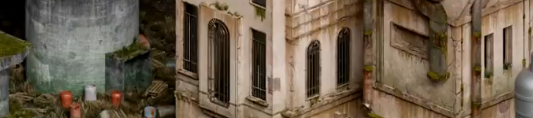
lets start with miettinens aging generator, if you have been following this series you have probably seen earlier versions of this, but this one feels much closer to a final pass, with ivy growth, water damage textures and scattering all working together. the before looks basic, just cubes and cylinders blocking out a small town, but the moment the generator adds those water leaks, rust streaks and vegetation overgrowth, it starts to feel like a place that has actually existed for years. not sure when it will be released, but if you want access you might have to reach out directly, and if all you need is the scattering part, that can already be used separately as assets.
New Sample sound visualizer in geometry nodes

you may not know this yet but sound is coming to geometry nodes in blender 5.2, the sample sound node gives you frequency and amplitude per frame, meaning you can drive anything procedurally, from points to instances to curves. here cartesian caramel is already showing what that looks like with clean visualizers, and this is just scratching the surface, once this lands properly it opens up a whole new category of motion work inside nodes without needing workarounds.
New Real uiButtons new vellum like particles
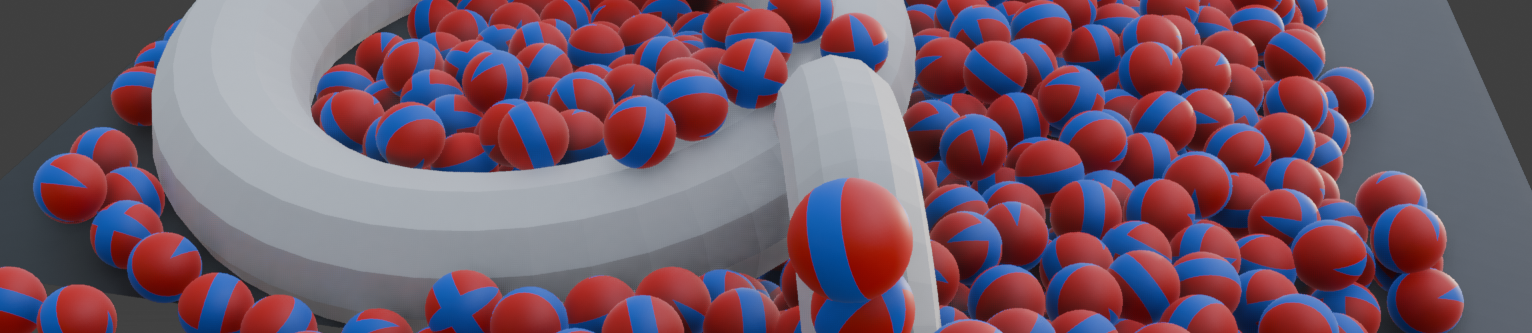
next up, lets look at a new particle system i have just added to my blender ui redesign to make blender easier to use, blenders particle system has always hard some limitations and one of the biggest one that always bothered me was the fact that the particles could not collide with each other so you could not create a pile of rocks, or sand, on top of that they dont rotate when they slide on the surface of any object which is also a big problem for creating vfx, you have to use rigid bodies which cant be emitted and are slow and to difficult to setup,
so my solution is to create a new particle system that solves those issues altogether, the particles can easily pile, and can also be exported as alembic files to other applications, its all part of my new realbuttons design to makes things just work,
procedural game in geometry nodes

its quite impressive what you can do with geometry nodes, here shahzod builds a full system where you guide a beetle by drawing obstacles and feeding it objects. the standout part is how it avoids collisions, all handled inside nodes without a traditional game loop. the timeline becomes your runtime, and everything is driven through proximity checks and point distribution, which is kind of wild when you think about it.
procedural detail
another great demo is a fluid style simulation running directly on a mesh with realtime deformation. the resolution is kept low for performance but the idea is solid, simulating surface based flow instead of relying on volume sims. getting this level of control with the built in tools is nearly impossible, it shows how far custom node setups can go when you step outside the defaults.
the power of sound based particle simulation

and if the visualizers were not enough, here are particles reacting to sound, hitting beats and bursting with energy. this would be perfect for music videos, where each instrument could drive its own emitter or force, instead of keyframing everything you let the audio handle the motion and it ends up feeling much more alive.
fake caustics

check out these fake caustics made by mysterypancake using geometry nodes, this technique has been around for years but still holds up because real caustics are still expensive to render in eevee. instead of calculating actual light bounces, a mesh is used to fake the effect and project the patterns, skipping all the heavy computation while still looking convincing.
books
the best way to discover new workflows is watching other creators using different programs than you use, this was kengo ito in cinema 4d with their procedural distribution generator. cinema 4d has its own system called scene nodes, and it goes beyond just geometry, letting you manipulate modifiers, particles and physics directly in one setup. instead of jumping between systems, everything lives in one pipeline, so the feedback loop is tighter and setups feel more connected. even if you never use it, watching how data flows through these systems can change how you build your own node setups.
plant growth
look at this amazing plant growth generator done in houdini by kengo ito, i love how it opens up in a natural looking way, each leaf must be real geometry since they all deform independently and nothing feels repeated. you can see slight variations in timing and bending that really sell the effect. i have tried something like this myself in geometry nodes but you don’t get the same level of detail, especially in how the stems twist and how the leaves unfold at slightly different rates instead of everything moving together.
this feels more real, maybe it’s the awkward growth, the small delays and uneven expansion instead of smooth linear motion, but also how the deformation feels layered, like there is noise and directional influence driving it. another thing that stands out is how the structure builds from the inside out, rather than everything scaling from zero, and that alone makes it feel more believable.
rock generator
look at this rock generator by corey corza, you use curves to define the shape and the system converts it into a volume mesh with displacement and materials. simple setup but very efficient, especially for game assets where speed matters more than perfection.
procedural chain link
check out this procedural chain link fence by hans chiu, the animation alone is satisfying, but what stands out is how stable it is, you can change thickness, spacing and turns without breaking the structure. setups like this really show how strong relationships inside nodes can be when everything is built properly.
making a procedural log
i love this breakdown of a procedural log by cgmatter, distributing thousands of points on a cylinder, instancing geometry, then cutting and deforming it to get bark detail. it is probably heavy to run, but this kind of experimentation is where most of the learning happens, even if it is not the most efficient approach.
what you can generate with curves and geometry nodes
look at how powerful curves can be, if you are running out of ideas for your next generator, staggart has a great demo for you. they are not using geometry nodes, i think it’s unity, but aside from the physics simulation everything here can be done in blender, from pipes to roads to cliffs and terrain.
once you start thinking in curves instead of meshes, a lot of problems become easier to control, you can reshape entire systems by adjusting a few points and everything updates automatically. the demo shows how curves act as the backbone, defining flow and structure, while detail is layered on top procedurally, which is exactly where geometry nodes shines.
transformer drilling
another great demonstration by faustkeinz, recreating the driller robot from transformers. the mechanical parts are straightforward, but the difficult part is getting particles to emit properly from the entire structure. it’s one of those setups where the complexity is not in the modeling, but in how everything interacts together.