
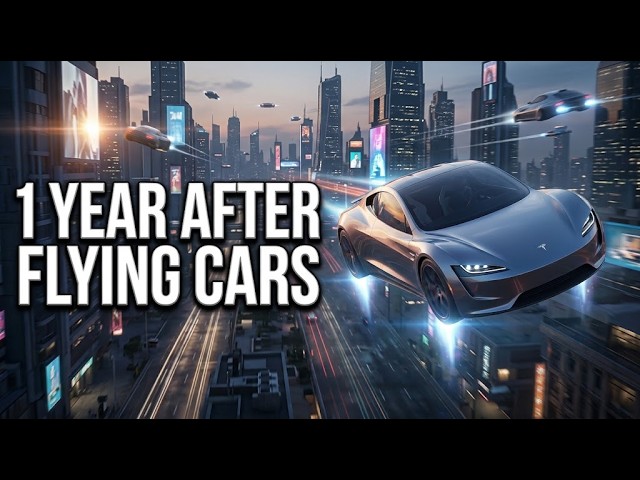




Picture your worst commute. Now picture lifting off the road, gliding over the stopped traffic, and landing at work in ten minutes. That image has sold the idea of the flying car for more than a hundred years. But imagine everyone gets one. The road empties, the sky fills up, and before long you're sitting in a traffic jam again, just higher up.
That's the flying car problem. The technology is getting real, but it may not deliver what people actually want from it: an end to traffic.
A hundred-year-old promise
The flying car is almost as old as the car. In 1917 Glenn Curtiss showed his Autoplane, an aluminium car body with wings; it could hop off the ground but never truly flew. In 1956 Moulton Taylor's Aerocar, a car that towed its own wings, became one of the first road-going aircraft approved by U.S. aviation regulators, though only a handful were ever built. The Terrafugia Transition flew in 2009, and in 2022 Klein Vision's AirCar received a certificate of airworthiness in Slovakia.
Most of today's serious projects aren't really cars at all. They're eVTOLs: electric aircraft with several rotors that take off and land vertically, like quiet, small helicopters. Companies such as Joby, Archer and EHang are building them as air taxis. In the United States, the FAA created new rules in 2024 for this kind of "powered-lift" aircraft. In China, EHang's two-seat autonomous aircraft received a type certificate in 2023. The sky is slowly opening up.
So the question is no longer just "can we build them?" It's "what happens if we succeed?"
Why traffic exists in the first place
Traffic isn't caused by a lack of road space; it's caused by too many people wanting to use that space at the same time. And when you add space, more people show up to use it.
Transport planners call this induced demand. Back in 1962, economist Anthony Downs described the "law of peak-hour expressway congestion": widen a busy road and drivers who had been avoiding it come back. They move from other routes, from other times of day, and from buses and trains, until the road is congested again. Later research found that, over the long run, the amount people drive in a city rises almost one-for-one with the road space it adds. Researchers call it the "fundamental law of road congestion."
Houston's Katy Freeway is the textbook example. In 2008 it was widened to more than 20 lanes in places, at a cost of billions of dollars. Within a few years, analyses found that peak-hour travel times on parts of it had got longer, not shorter.
Flying cars are the biggest road widening anyone has ever proposed. They don't add one lane; they add a whole new layer of the city. If induced demand works on the ground, there's every reason to expect it to work in the air.
The sky isn't empty space
Looking up, the sky seems endless. But aircraft can't pack together like cars. They need far more space between them, both side to side and above and below, because they can't simply brake and stop.
- Capacity: a single freeway lane can carry around 2,000 cars an hour. Air corridors with safe separation between vehicles would carry far fewer per "lane". To match a busy motorway, you would need many stacked layers of sky traffic, all moving over people's homes.
- The landing bottleneck: every flight starts and ends on the ground. Vertiports, the landing pads, would become the new on-ramps and exits. A pad that can only handle a vehicle every minute or two creates a queue in the air.
- Traffic control: today's air traffic control manages a few thousand aircraft in a region with trained pilots. A sky full of flying commuters would need fully automated traffic management, something like the "UTM" systems that NASA and regulators are developing for drones, at a scale that has never been tried.
In other words, the sky has jams too. They're harder to see coming, and much harder to step out of.
What flying cars would genuinely improve
None of this means flying cars are a bad idea. There are real advantages:
- No roads to build. Rivers, mountains, islands and traffic bottlenecks stop mattering. A route that needs a bridge or a tunnel on the ground is just a straight line in the air.
- Point-to-point travel. A trip that winds through a road network for an hour could, in principle, be a 15-minute direct flight.
- Emergencies and remote places. Medical transport, disaster response and connecting rural areas are the strongest uses. Most of them don't depend on thousands of vehicles flying at once.
- Electric and quieter than helicopters. eVTOLs promise lower running costs and less noise than the helicopters that fill this role today.
The costs we don't see on the poster
- Noise. One quiet aircraft is fine. Hundreds overhead, all day, add up to a constant hum that today's cities don't have.
- Energy. Hovering takes far more power than rolling on wheels. A 2019 study in Nature Communications found that for a 100 km trip, a fully loaded eVTOL could beat a petrol car on emissions, but a single passenger would still be worse off than in an electric car. For short city hops, flying is the least efficient option.
- Safety. When a car breaks down, it pulls over. When a flying car breaks down, it falls, possibly onto a street full of people. Flying everyone safely would need certified maintenance, automation and backup systems well beyond what cars have today.
- Weather. Strong wind, storms, fog and icing can ground flights, often during the rush hours when everyone needs to travel.
- Who gets to fly? Early air taxis will be expensive. A sky reserved for people who can pay could simply move the rich above the traffic while everyone else stays in it.
- Privacy and the city below. Low-flying traffic looks down into backyards and windows, and the noise and shadows land on neighbourhoods that get none of the benefit.
What actually reduces traffic
If more space doesn't fix congestion, what does? The few measures that work tend to manage demand rather than add capacity:
- Congestion pricing. Charging drivers to enter busy areas at peak times cut traffic in London (2003) and Stockholm (2006, where traffic over the charging cordon dropped by around 20%). New York started its own scheme in 2025.
- Public transport. A train line moves tens of thousands of people an hour through a space a few metres wide.
- Land use. Homes, jobs and shops closer together mean shorter trips, or no trip at all.
- Remote and flexible work. Spreading out the rush hour helps every mode of transport, including any future air taxi.
Flying vehicles could be a valuable part of this mix, for emergency services, for remote areas, and for connecting airports and cities. As a replacement for the daily commute, they run into the same basic rule as every new road.
Traffic always comes back
The flying car problem is not that the machines don't work. It's that a traffic jam isn't really a technical problem; it's about how many people want to travel at once. Give a city a whole new sky, and it will fill up, just as every new lane has.
The short film above tells that story in four minutes: on day one a single flying car crosses the sky. Over five years the road empties, the sky fills up, and then the air lanes jam so badly that people go back to driving. By the end there are two traffic jams, one stacked on top of the other.
Maybe one day we'll all fly to work. But unless we change how many of us need to travel at the same time, we'll be stuck in traffic up there too.
Watch the film: The flying car problem. What do you think: would flying cars fix traffic or just move it up a level? Let us know in the comments.