



AI can write code. It can generate video. It can even drive Blender now. So why, when I hit F12, am I still sitting there watching Cycles chew through samples like it's 2015? Why don't we have AI-powered rendering yet?
Now, I don't mean a denoiser like OptiX. I don't mean upscaling like DLSS. And I definitely don't mean diffusion, where you block out a few cubes and the AI dreams up a pretty picture on top. I mean a real render engine. If my scene is bad, my render comes out bad. No interpretation, no hallucination, no thinking for me.
I mean an AI that was trained on Cycles, to render like Cycles, giving me the exact image Cycles would give me. Just way faster. And guess what? There's one already.
Let's get into it.
Why that's a different thing
Before we meet it, let's be clear about why the stuff you already know doesn't count.
A denoiser like OptiX or Open Image Denoise is a neural network, sure. But it can't do anything on its own. Cycles still has to trace the rays and give it a noisy image first. The AI just cleans up after the path tracer. DLSS is the same deal. Something has to render the frame before the AI can upscale it or invent the next one. The AI is the cleaner, not the builder.
Diffusion is the opposite problem. It doesn't need a renderer at all, because it isn't really looking at your scene. It looks at a rough guide and imagines something nice on top. Your materials, your exact lighting, your mistakes? Gone. It's an artist, not a renderer.
What I want sits right in the middle. An AI that reads my actual scene, every mesh, every material, every light, and does the whole job of the path tracer. Faithfully. And honestly, the idea isn't even crazy. If companies can train AI models like Claude and ChatGPT to use Blender, why can't someone train one on Cycles itself? Feed it millions of scenes and their Cycles renders, until it simply knows what any scene would look like when Cycles renders it.
Well. Somebody did exactly that.
Meet RenderFormer
It's called RenderFormer. It comes out of Microsoft Research Asia, working with Zhejiang University and the College of William & Mary, and it was presented at SIGGRAPH 2025, which is basically the Olympics of computer graphics.
Links: Project page · Paper (arXiv) · SIGGRAPH talk (YouTube) · Microsoft Research blog
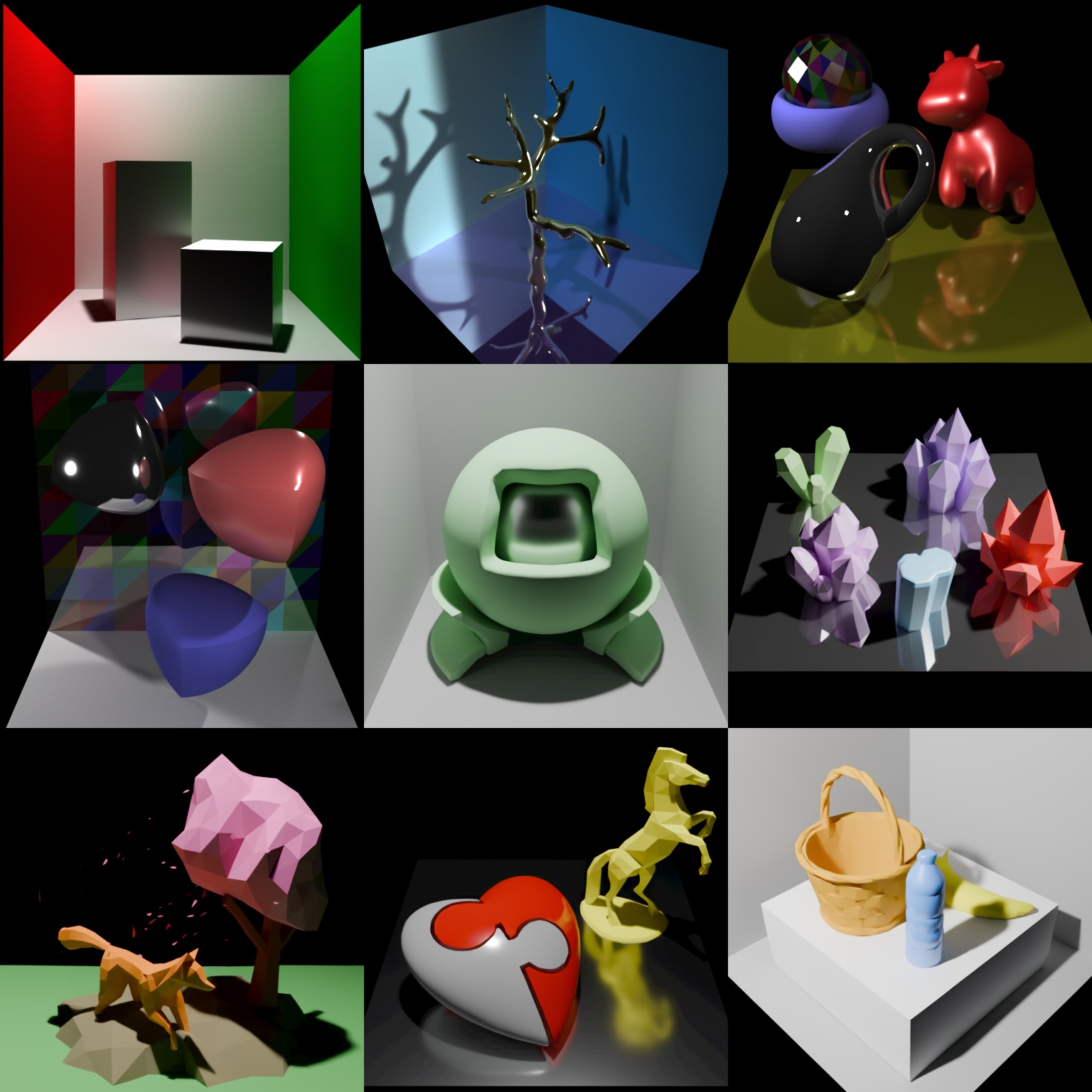
Here's what makes it different from everything else with "neural rendering" in the name. A lot of neural rendering you've heard of, like NeRFs and Gaussian splats, is trained on one specific scene. You capture a room, the model learns that room, and it can only show you that room. RenderFormer doesn't work like that. You give it a normal triangle mesh scene, the same kind of thing you'd build in Blender, with materials and lights and a camera, and it renders the image directly. No per-scene training. No fine-tuning. Just scene in, image out.

And it's not faking the hard stuff either. It produces full global illumination: soft and hard shadows, glossy reflections, diffuse light bouncing off walls, multiple light sources. The things that make path tracing slow are exactly the things it's trying to learn.


Now here's the wild part about how it works. There's no ray tracing. There's no rasterization. Instead, RenderFormer treats rendering like a language problem. Every triangle in your scene becomes a token, a bit like a word in a sentence, carrying its material properties. A transformer, the same basic architecture behind models like ChatGPT and Claude, reads all those triangle tokens and works out how light moves between them. Then a second transformer takes the camera's point of view and turns all of that into patches of pixels.
So instead of simulating billions of light rays, it's basically translating a sentence made of triangles into an image.

And guess where the training data came from. The researchers took 3D objects from Objaverse, an open dataset with hundreds of thousands of models, dropped them into scene templates with random materials and lighting, and rendered all of it in Blender. In Cycles. The model learned what light looks like by studying Cycles renders.
That idea we just had, train an AI on Cycles until it knows what Cycles would do? That's not a fantasy. That's literally the paper.
The catch
So why aren't we all using it? Why isn't there a RenderFormer button in Blender's render engine dropdown right now?
Because the first version came with some pretty big asterisks.
Asterisk number one: scene size. The original RenderFormer could only handle scenes up to 4,096 triangles. Let that sink in. The default Suzanne monkey, subdivided once, is already in that ballpark. My destroyed city generator spits out more triangles than that in a single building chunk. This thing was rendering Cornell boxes, Stanford bunnies and Utah teapots. The classic test scenes of graphics research, not production work.


Asterisk number two: materials. Version one had no textures at all. Each triangle got one constant material. No image textures, no procedural noise, no fancy node trees. If you've ever built a shader in Blender with forty nodes plugged into a Principled BSDF, that whole idea simply didn't exist yet.

And asterisk number three is the sneaky one. RenderFormer is fast. But part of why it's fast is exactly because of those first two limits. A few thousand triangles with flat materials is a much easier problem than a real scene. So when you hear "neural renderer beats path tracing," you have to ask: on what scene?
That's the thing about research papers. They prove something is possible. They don't prove it's ready.
RenderFormer-V2
But this is AI research, and AI research doesn't sit still. Just last month, in September 2026, the follow-up dropped: RenderFormer-V2.
Links: RenderFormer-V2 paper page (alphaXiv)
And the list of new features reads like someone went through the V1 limitations and crossed them off one by one. Caustics. Volumetric scattering. Environment lighting. Textured surfaces. Displaced surfaces. Even refraction, all without any specialized physics code written for those effects. It just learned them.
The training data got a massive upgrade too. V2 was trained on ten million procedurally generated scenes, all rendered with Blender Cycles. Ten million. That's Cycles teaching an AI how light works, one render at a time.
But here's the detail I find most interesting. The researchers don't pitch V2 as a Cycles killer. They describe it as complementary to physics-based renderers. Not a replacement. A partner.
And I think that word choice tells you a lot about where this is actually heading.
Why it's not in Blender yet
So if the research exists and it's improving this fast, why don't we have it in Blender? I think there are four big walls, and they're worth understanding, because they're the same walls any AI tool for artists runs into.
The first wall is trust. Cycles is wrong in a very honest way. When it hasn't finished, you see noise, and the noise goes away the longer you wait. You always know where you stand. A neural renderer is wrong in a confident way. If it misjudges how light bounces off your wall, it doesn't show you noise. It shows you a clean, beautiful, plausible image that just happens to be incorrect. And remember my rule: if my scene is bad, my render should be bad. The moment an AI renderer quietly fixes things, or quietly breaks them, it stops being a renderer and becomes an interpreter. For product renders, architecture and VFX, "plausible" is not good enough. Clients want their exact chair, lit exactly right.
The second wall is scale. Transformers get expensive fast as the number of tokens goes up, because every token has to pay attention to every other token. Triangles are tokens. Production scenes have millions of them. Going from a teapot to a city isn't a small step. It's a completely different problem.
The third wall is the node editor. Cycles can render any shader you can build. Any weird node setup, any custom OSL script, any combination nobody has ever tried before. A neural renderer only really knows the kinds of materials it saw during training. The researchers say V2 handles out-of-distribution materials, and that's genuinely impressive, but Blender users are professionally creative people. We will find the material that breaks it within an hour.
And the fourth wall is that Cycles keeps getting faster. A neural renderer isn't competing against the slow Cycles of 2015. It's competing against GPU Cycles on a modern RTX card, with a denoiser on top, which is already pretty quick for most scenes. The finish line keeps moving.
And then there's the wall I keep coming back to on this channel: the last mile. The paper exists. The code is on GitHub. The models are on Hugging Face. But there is no Blender addon that takes your scene, converts it, and hands you back a render in the Image Editor. Someone has to build that bridge. Someone has to turn research into a tool an artist can actually click.
Links: Code on GitHub · V1.1 Large model on Hugging Face · Example video scenes
So, why don't we have AI-powered rendering?
The honest answer is that we're closer than almost anyone realizes. Not the denoiser kind, not the diffusion kind, but the real thing. Right now, a transformer trained on ten million Cycles renders is learning to do the whole job, caustics and fog and refraction included.
But I don't think the future is a magic button that replaces Cycles overnight. I think it looks a lot more like what the researchers themselves hinted at. Neural rendering working alongside path tracing. Maybe AI gives you an instant, near-final preview while you're lighting, and Cycles does the final frame. Maybe AI handles the background buildings and the fog, and Cycles handles the hero product in front. Maybe the denoiser just keeps getting smarter until one day we realize it's doing ninety percent of the work.
And that's the funny twist in all of this. The AI that might one day replace Cycles is being taught by Cycles. Every render it learns from is a render Blender made. Which means Cycles isn't just a render engine anymore. It's a teacher.
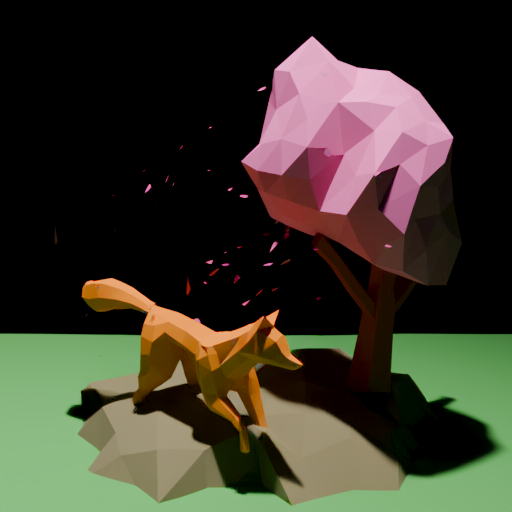
Links: Animation rendered by RenderFormer (MP4)
Whether the student ever graduates? That depends on whoever builds the last mile.
Let me know in the comments: would you trust a neural renderer for your final frames, or only for previews? And if you want to try RenderFormer yourself, I'll leave the links down below.
Sources
- RenderFormer paper (arXiv)
- RenderFormer project page
- Microsoft Research blog post
- RenderFormer code (GitHub)
- RenderFormer-V2 (alphaXiv)
