
Why AI Can’t Replace VFX Artists
AI video can produce a shot that looks incredible. The harder question is whether you can change one detail without losing everything you liked about it.
I ran into that problem while trying to make a short film about a daily gravity fault. Some of the results looked better than I expected. But the moment I needed consistent action, specific camera movements, or a correction that preserved the rest of the shot, progress became a struggle.
Watching a Frozen 2 effects breakdown made that difference even clearer.
What the Frozen 2 Breakdown Reminded Me About VFX

Frozen 2 ice bridge destruction breakdown. Image: Walt Disney Animation Studios, via SideFX.
There’s a sequence where Elsa tries to make her way over enormous waves. What caught my attention was the amount of work behind those few seconds: the direction, the details, and the control needed to bring everything together.
The water has to feel dangerous, but we still need to follow Elsa. Her movement has to connect with the surface beneath her. The framing needs to communicate the scale without losing the character.
SideFX’s production article explains that the wave choreography was important enough for base simulations to be created before layout and animation. Artists could then stage Elsa’s performance against the moving water.
Watch the Frozen 2 Houdini FX breakdown:
That’s what stayed with me: all those technical decisions serving a scene that had to work in a very particular way.
An Impressive Shot Can Still Be the Wrong Shot

Breaking-wave development for Frozen 2. Image: Walt Disney Animation Studios, via SideFX.
When we see a good AI generation, it’s easy to assume we’re looking at exactly what the creator wanted. We don’t see the rejected attempts, the details they couldn’t fix, or the original idea they abandoned because the model kept giving them something else.
A shot can look incredible to the viewer and still be a compromise for the director.
Maybe the camera needs to hold for another second so a joke lands. Maybe a character needs to notice something before the audience does. Maybe the lighting needs to conceal a detail until the next shot.
Those decisions affect what the scene means.
When I think about movies like Frozen, Cars, or Interstellar, I remember specific moments: a reaction, a reveal, the timing of a cut, or the music arriving at exactly the right point.
Control alone doesn’t make a great movie. You still need strong writing, characters, and performances. But you need enough control to bring those things together.
Why Galvatron’s Transformation Lost Me

Thumbnail from the Galvatron first-appearance clip linked below.
I remember watching Transformers: Age of Extinction and seeing Galvatron, the rebuilt version of Megatron, transform by breaking into a cloud of little blocks and reforming.
I almost walked out.
Watching mechanical parts fold, rotate, and lock into place was a huge part of the appeal for me. You could follow a vehicle becoming a character. There was weight and a satisfying sense of machinery behind it.
Replacing that with a cloud of particles took away something I loved.
Watch Galvatron’s first-appearance sequence:
I’m not claiming the effect was easy to make, or that the artists literally threw a particle system on him and called it a day. But that was how it felt to me as a viewer. The result lost a quality I associated with those movies.
A technically impressive effect can still be the wrong creative choice.
My Experiment: A World Where Gravity Fails Every Day
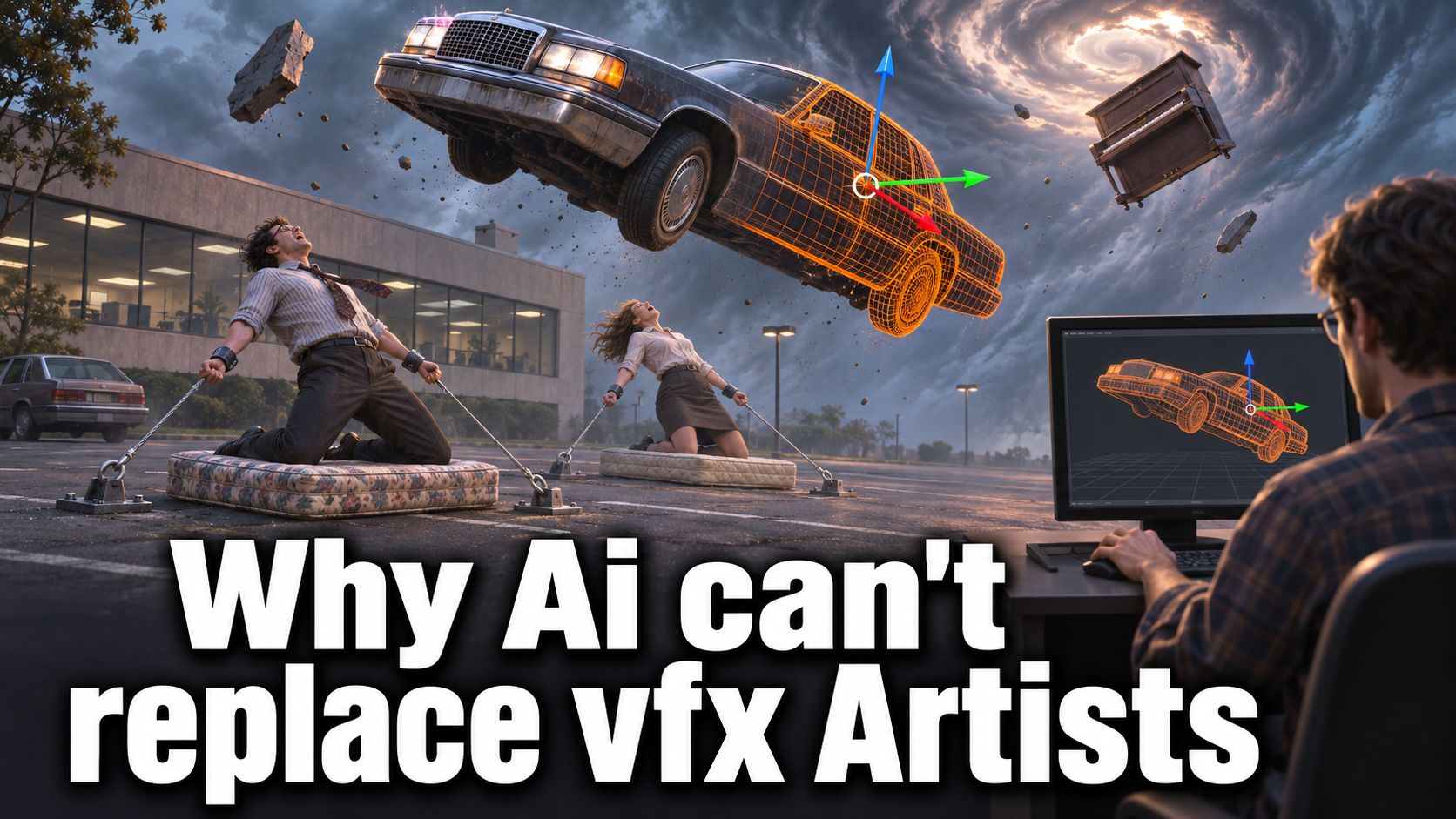
My short-film idea was called Antigravity. It takes place in the nineties, in a world where gravity fails for thirty seconds every day around lunchtime.
It’s been happening for ten years. People have adapted.
They still go to work. They still complain. They still make stupid jokes. They just have to strap themselves to the ground before lunch.
The opening follows two colleagues in an office. One is trying to beat a high score on his computer while a small green countdown sits in the corner. When the warning turns red, it takes over the screen and interrupts his game.
He’s annoyed about losing the high score. That’s how normal the daily emergency has become.
As everyone heads outside, his colleague asks about a prisoner who supposedly tried to escape by refusing to strap himself down. The lift doors close, then open downstairs as he finishes the joke: “Maybe he made it to the moon.”
Outside, a soldier hands them mouth guards and checks their wrist restraints. Cars and bikes have their own anchors. Old mattresses lie beneath everyone’s assigned places.
I wanted the mattresses to look worn out. People have been landing on them every day for years. Their condition helps tell the story without an explanation.
I Wanted Horror. I Got a Theme-Park Ride.
The first part came out okay. But the moment gravity was supposed to switch off, getting the action I wanted became a nightmare.
Even the restraints wouldn’t stay consistent. They would start attached to people’s wrists, then a wide shot would suddenly show them connected to their legs.
In this fictional gravity fault, the effect is a violent upward pull. I wanted people fighting against their restraints, straps snapping, and unsecured cars and furniture shooting into the sky. Every cut should make you wonder whether someone’s restraints are about to give way.
Instead, some attempts looked like everyone was on a ride at Disneyland.
I wanted force, panic, and danger. What I kept getting felt too much like people enjoying a float through the air.
That changes the entire mood of the scene.
The Mattresses Were Part of the Story
When gravity returns, everything should come crashing down.
People hit their mattresses. Cars slam into the ground. Furniture and debris rain down around them. The mattresses give the characters something to land on, but landing isn’t the end of the danger.
I wanted them to immediately pull the mattresses over themselves. They know that everything launched into the sky is about to fall back down.
The final shot was supposed to be a piano crashing between the two main characters just after they duck underneath their mattresses. One last violent impact, narrowly missing them, before the cut to black.
Those were the moments the earlier shots needed to set up. If the generated footage couldn’t follow that sequence, it wasn’t giving me the scene I needed.
Fix One Thing, Lose What You Liked
Every correction attempt seemed to introduce another problem.
I’d get the straps in the right place but lose the camera movement I liked. Another attempt might improve the movement while changing the characters or ruining the timing.
I couldn’t build on a good result because the parts that worked wouldn’t stay fixed.
Eventually, I was choosing which mistakes I could live with instead of getting closer to the scene I wanted.
The same problem affected continuity. Once the office screens turn red and everyone starts leaving, the next shot needs to continue from that state. We can’t return to an ordinary office where people are sitting down as if nothing happened.
In the setup I used, I was working with clips of up to thirty seconds and could only extend a clip once. That describes my workflow at the time, rather than a universal limit on AI video.
Short clips alone weren’t the issue. Movies are assembled from short shots. The problem was getting those shots to agree about what had already happened.
Without AI, I Wouldn’t Have Attempted This Film
Despite all that frustration, AI made this experiment possible.
I couldn’t fund a live-action version. I couldn’t realistically finish the entire project in Blender by myself with the time and resources I have. Making it as an animated film would still be an enormous undertaking.
AI put a version of the idea within reach.
Some generations even surprised me in a good way. A composition, an expression, or an atmosphere could turn out better than I had imagined. That has real creative value.
But I was also the director, editor, producer, and the person deciding which compromises were acceptable. I could rewrite the story around the footage whenever I wanted.
Client work makes that much harder.
What Happens When the Client Gives Notes?
Imagine getting feedback like this:
- “The shot is approved. Just move the actor a little to the left.”
- “Keep that expression, but have him look towards the door.”
- “We have a Coke sponsor now. He needs to hold a bottle with the label facing the camera.”
- “Keep everything else exactly the same.”
Generating another attractive shot doesn’t necessarily satisfy those notes. You need to deliver the requested change while preserving what was already approved.
Even a logo can generate pages of discussion. The famous Arnell Group Pepsi redesign document runs to twenty-seven pages. Whatever you think of its reasoning, it shows how much explanation can surround something a viewer barely pauses to look at.
Read the Pepsi design strategy PDF.
Now consider the decisions in a scene with multiple characters, dialogue, props, camera movement, and a fictional world whose rules need to remain consistent.
An impressive clip alone doesn’t tell you whether a workflow can handle those requirements. You need to see what happens during revisions.
Why VFX Artists Still Matter
My experiment showed me how much visual quality AI can deliver, and how quickly that advantage becomes frustrating when I need precise, repeatable changes.
VFX artists bring judgment about timing, weight, composition, continuity, and how an effect supports the story. They also help turn feedback into specific changes that can be reviewed and refined.
Traditional production has its own expensive revisions and technical problems. But the ability to work on separate parts of a shot gives artists ways to preserve good decisions while changing others.
AI can be part of that process. My experience makes me interested in workflows where generated footage is combined with editable 3D scenes, compositing, and deliberate animation. The result needs to stay manageable after the first impressive preview.
I still want to make Antigravity. To finish it, I need a workflow where a good decision survives the next revision.
Give me an impressive shot and I’ll be impressed. Let me change one thing without losing everything else, and I can actually keep making the movie.