


You’ve seen what Geometry Nodes can do. You’ve also seen AI agents build worlds, games and models in minutes. At that speed, you kind of have to do the YouTuber thing. Geometry Nodes versus AI. Is Geometry Nodes cooked? Is it dead?
With that out of the way, let’s look at what’s actually happening, minus the hype and the doom predictions.
I’ve built an original building generator, destruction tools and a destroyed-road tool with Geometry Nodes. I’ve also built quite a lot with AI. That makes the question personal. If an agent can make the building I need while I’m still thinking about the node tree, how much time should I spend learning to build the generator myself?
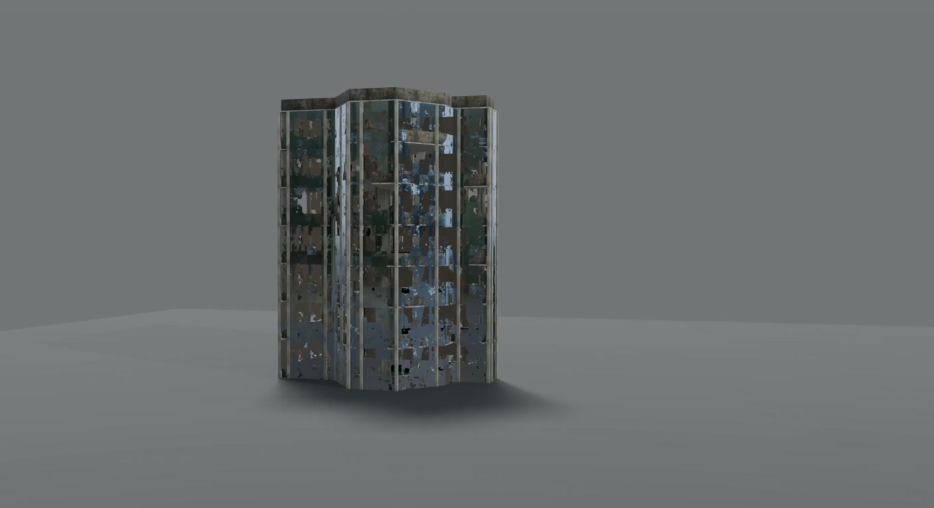
One of my procedural building examples. Being able to make a convincing asset is only the beginning of making a reusable tool.
You already paid for the AI subscription
You can ask Fable or Astra for a building. You can also buy something like Isak Waltin’s Procedural Building Generator 2 and edit the architecture with familiar Blender operations, including moving geometry and extruding faces.
The subscription is what makes the comparison interesting. If you already pay for Claude or ChatGPT, and your plan covers the agent workflow you use with Blender, trying a building may cost you nothing extra within that allowance. Why buy a separate generator?
For one building at the back of a shot, I’d try the agent. A reference image and a few corrections can get you close to what you need. If the balcony lands on the wrong corner, highlighting it in a screenshot can be much easier than describing its position in a paragraph.
Then suppose you want that building to become the rest of the street. You ask for a floor count. Two floors work. At six floors, a balcony repeats across the shop sign. You fix that, extrude a new wing and discover windows facing into the wall. Those are illustrative revisions, but the afternoon they describe will be familiar to anyone who has tried building tools with AI.
The first version arrives quickly. Testing and maintaining the generator can take over the time you meant to spend making the film.
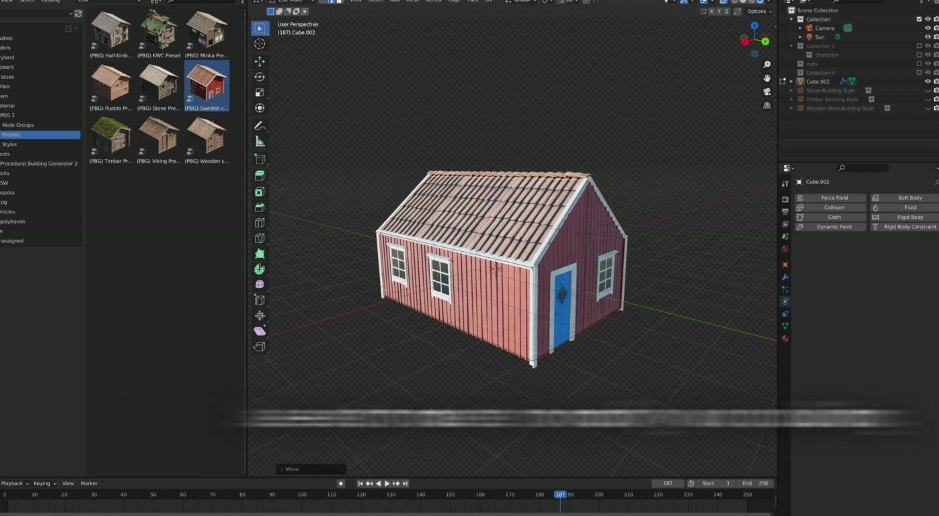
Procedural Building Generator 2 by Isak Waltin. A finished tool gives you a starting point for the revisions that follow the first building.
Explore Procedural Building Generator 2
The file stays yours. Access to the agent can run out.
In my tests, agents usually reach for Python. Python can create a proper procedural generator, expose controls in Blender or build a Geometry Nodes modifier. If I can close the chat and change the floor count tomorrow, I have something useful.
If my only practical way to revise the building is to ask the agent to rewrite its script, my deadline depends on my remaining usage. Claude documents both session and weekly limits on paid plans. Depending on when I hit them, I might have hours or days left until a reset. Eligible users can pay for more usage.
The Blender file and saved code remain available. Manual edits and local controls continue to work. The dependency comes from needing another model response to make the next change. A purchased generator with local controls lets me keep revising within the version I own, subject to its license and Blender compatibility.
Read Claude’s usage-limit documentation
Why I’d still buy an artist’s generator
A useful comparison includes the assets, artistic decisions and testing behind the tool. That is where specialist generators become difficult to replace with an afternoon of prompting.
The City Generator — Andreas Dürr
A distant skyline is a reasonable job for an agent. Put the camera on a bus and move through it, though, and the streets become much more important. You want a connected layout, traffic and a way to explore the same city after dark.
The City Generator already puts those decisions within reach. I’d use that foundation and spend my detailed modeling time on the shop where the bus stops. An agent could help make its unusual balcony or crooked awning while the generator handles the surrounding city.
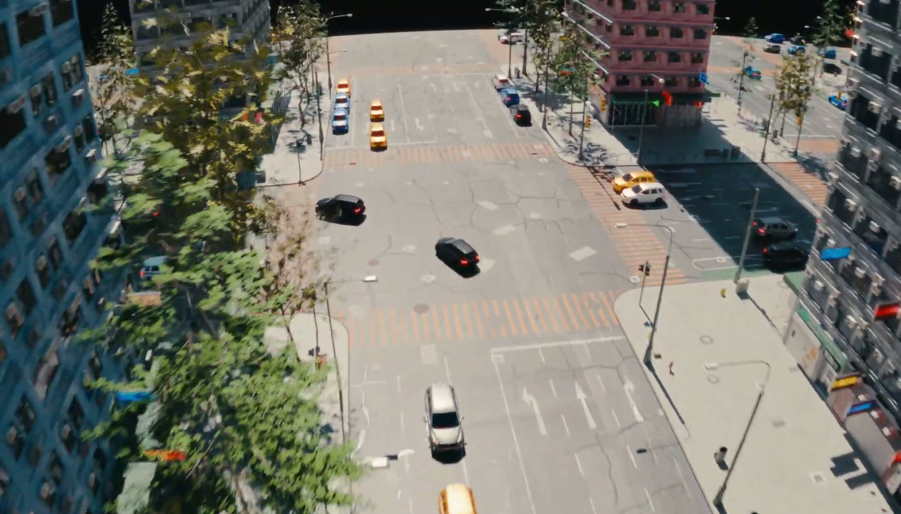
The City Generator by Andreas Dürr. Street-level detail changes what you need from a generated city.
The Nature Generator — Andreas Dürr
Look at a rock at the edge of a river. I want a darkened wet area, dry stone above it and some moss breaking up the outline. Pull the camera back, and the surrounding rocks need to belong to the same place.
The Nature Generator combines procedural geometry, scattering, water and surface controls such as moss and wetness. What interests me is how those pieces work together visually. I can get an agent to make a nice rock. Matching a whole editable library at that level of finish is a job I wouldn’t take on for the price of the add-on.
The Nature Generator by Andreas Dürr. Shape, surface detail and variation all contribute to a coherent environment.
Geo-Scatter — BD3D
A script can put thousands of plants on a hillside. Zoom in, and the quality of the nearest plant starts to matter. So do the choices about what grows beside it, how dense it gets and where the composition needs an opening.
Geo-Scatter’s workflow and compatible biome libraries let artists share those decisions. Check which assets and biome packs come with the edition you choose. I’d happily use a specialist’s setup for the hillside and put my own modeling time into the flower closest to the camera.
Geo-Scatter by BD3D. Asset selection and distribution both affect the final environment.
Baga River — Antoine Bagattini
Baga River lets you draw a river through terrain, change its width along the curve and dress the banks with supplied assets. Its listing includes more than thirty ready-to-use assets.
Getting an agent to run a strip of water along a curve is a manageable experiment. Making a river tool behave across unfamiliar terrain, with dressed banks and responsive viewport performance, takes more testing. On a project deadline, I would take the artist’s tool.
Baga River by Antoine Bagattini. The river path and its surrounding environment need to work together.
Does Geometry Nodes cost more tokens than Python?
I don’t have a universal number I would trust. A Python loop can place windows with very little code. Creating and connecting individual nodes can take more text. Reusing a finished node group can make that same task much shorter.
The ProcFunc researchers at Princeton reported a representation with 33% fewer code characters in a Blender editing benchmark. Yet the mean geometry-editing cost across their tested models was slightly higher with ProcFunc, at $2.83 compared with $2.68 for the Infinigen interface.
That experiment compared interfaces for editing procedural assets. It does not establish the cost of building a raw mesh versus a Geometry Nodes setup. It does show why the length of the final script is a poor substitute for measuring the completed workflow. Screenshots, model reasoning and retries can all contribute to the bill.
For my own building, I’d compare the cost and time required to reach an acceptable result, then make the same awkward revision in both versions. Once a useful control exists locally, I can change my mind repeatedly without sending another request to a model.
Read the ProcFunc study and its editing results
AI is changing what I bother to build
While trying to make my own Houdini, I realised how much an agent could fake. Falling debris or bending metal can look convincing with authored motion. If the timing feels heavy and the object lands where the camera needs it, that can be enough for a shot.
Move a car underneath the falling metal and the old animation may pass through the bonnet. For one shot, I might correct it. If layout keeps moving cars around, a collision system becomes worth setting up.
My destroyed-road tool makes a similar case. For one slab hiding a wheel, I’d circle it and ask for a correction. For the amount of rubble across the whole road, give me a slider. I want to try a few densities and see what feels right.
I also expect AI to put pressure on some add-on prices. That is my prediction, rather than a measured market trend. A tool seller is now competing with what a customer can produce using an existing subscription. As a buyer, I would still pay more for better assets and controls I use every day.
Would I still learn Geometry Nodes?
If I wanted to become the technical artist making the next City Generator or Baga River, absolutely. Building tools for other artists calls for experience with procedural rules, performance, testing and the way a scene responds to revisions.
If my priority were finishing films, I’d spend less time rebuilding every generator from an empty node tree. I’d learn enough to inspect a setup, understand the controls that matter to my shot and adapt it when necessary.
For the bus shot, I’d buy the city, ask the agent for the odd balcony on the corner shop and use my destroyed-road setup near the wheel. Then I’d play the shot. There is every chance the bus goes past the balcony too quickly for anyone to see it.